Prehistoric Planet: Ice Age VFX Team Completes Reddit’s Ask Me Anything
Production VFX Supervisor Russell Dodgson, Creature Supervisor Dorothy Ballarini, and Lead Scientific Consultant Darren Naish answer the film and scientist community burning questions on everything Prehistoric Planet: Ice Age.
Here are some of our highlights, covering everything from how the team simulated snow, the full VFX pipeline, and the specific camera techniques used to create an authentic documentary feel.
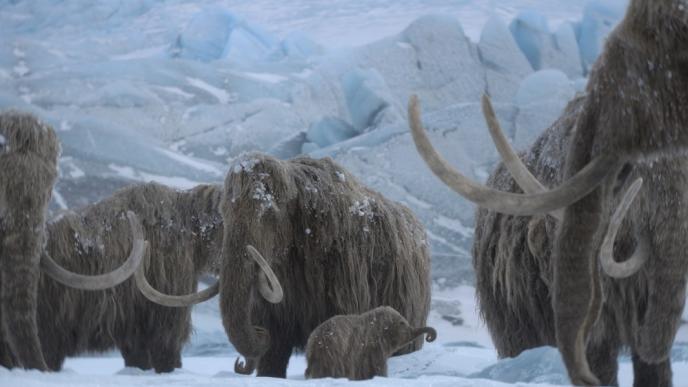
Q: Was the snow on the Mammoth in the snowstorm simulated physics, or was it placed manually?
A: Although everything is simulated, it's not simply a matter of pressing a button. We create groom particles on their fur that mimic snow clumps. Our FX artists then run several simulation passes to make the snow stick, slide, and clump naturally, adjusting repeatedly until it looks right. While physics-based, the process is highly art-directed, involving lots of iteration for the perfect look.

Q: What does the pipeline look like for the average vignette? How are the subjects decided upon, and how much change happens between pre-vis and the final cut?
A: Very roughly, the pipeline looks like this: once the story team and Darren agree on the animal, its behaviour and the overall beat of the scene, Russell and the production team plan where to shoot the plates and how to frame them. At Framestore, we then build the creature from scratch: modellers sculpt the anatomy, texture artists paint the skin and colour detail, groomers create the fur or feathers, riggers build the internal skeleton and controls, and lookdev artists make sure the surface reacts to light like real skin or fur, all constantly checked against Darren’s notes. The creatures then move to the animators, who will start blocking where the animals are, how they move, and then finally animate them. After that we push into detailed animation to bring the creature to life, and our CFX team layers on all the secondary motion: muscles, fat, skin sliding, fur, snow, mud and water. Finally, lighting and compositing integrate everything back into the plates. A lot changes between previs and final: timing, camera shake, subtle behavioural nuances, but the core story beat and the grounded science stay very close to the original brief.
Q: How did you manage to make these animal animations so lifelike, looking like a filmed documentary?
A: The truth is that it is a load of different, small data points that when added together give that authentic documentary feeling. For the animation, Framestore seems to be blessed with one of, if not the best, animation teams in the world. They have a true understanding of weight, motion, physiology etc. Then to get the documentary feel it is loads of tiny details such as…
- Lack of continuity. We wanted to feel like the stories played out of time and distance, so we shot it that way, even though it made the vfx harder,
- 1000mm lenses were another painful yet essential part as they give a ver specific aesthetic.
- The camera work being reactive, hence the use of puppets.
- The focus is not always being perfect.
- lots of heat haze, even in cold climates.
- camera jitter to remind the audience that the camera exists in the same space as the creatures.
Read the full Q&A here.


Prehistoric Planet and Framestore in the Press

First look at the snow sloths of “Prehistoric Planet: Ice Age”
