Heart of the Beast
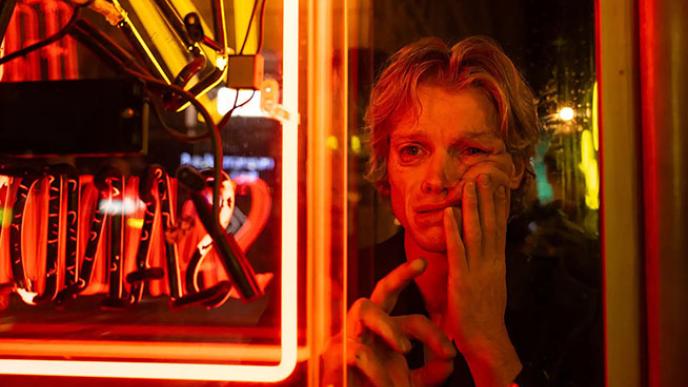
From acclaimed filmmaker David Ayer, Heart of the Beast is an intense adventure thriller that explores the unbreakable bond between Special Forces officer James Belmont (Brad Pitt) and his combat dog, Odin, as they face their greatest battle yet—the Alaskan wilderness. François Dumoulin serves as the film's overall Production VFX Supervisor, with Nicolas Chevallier supervising the incredible work delivered by our teams in Montreal and Mumbai. Postvis courtesy of our London-based FPS team led by Visualisation Supervisor Vincent Aupetit.
Only in theatres September 25, 2026.
Odin: The Heart of the Story
At the core of the film is a deeply emotional bond between a traumatized veteran, James, and his military working dog, Odin. Framestore was selected specifically because of its proven ability to create photoreal animals capable of carrying dramatic storytelling. While the production utilized a hero German Shepherd named Uber (and 3 backup dogs from the same family), aiming for a highly practical and authentic feel, the intense emotional range required by the script, spanning deep sorrow to fierce aggression, was beyond the capabilities of even the best-trained animals. While approximately 70% of the final film utilizes the live-action dogs with subtle 2D adjustments, close to a 100 shots rely on a completely CG Odin to perform actions that were impossible or unsafe for real animals.


A significant challenge arose in post-production regarding Odin's emotional performance. "The real dog was simply too nice for some of the grittier scenes," Francois Dumoulin notes. Therefore, the character work for Odin required balancing performances from four real dogs with a fully digital counterpart to create a seamless, single-screen identity. Unlike wildlife work based primarily on biological accuracy, Odin required deliberate character design and performance development comparable to a human actor.
By creating a digi-double that matched the live-action dog in every detail, our animators could fine-tune Odin's performance, ensuring every ear twitch and snarl landed with emotional accuracy
For hybrid shots, Framestore executed a surgical CG intervention without losing the authenticity of the live photography. Using high-resolution scans and photogrammetry of the on-set dog, animators tracked the dog's head and completely replaced the lower jaw and muzzle in CG, changing the dog's expression from curious to furious.
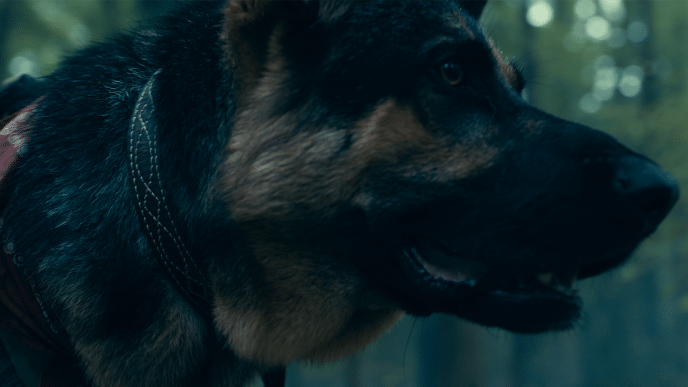
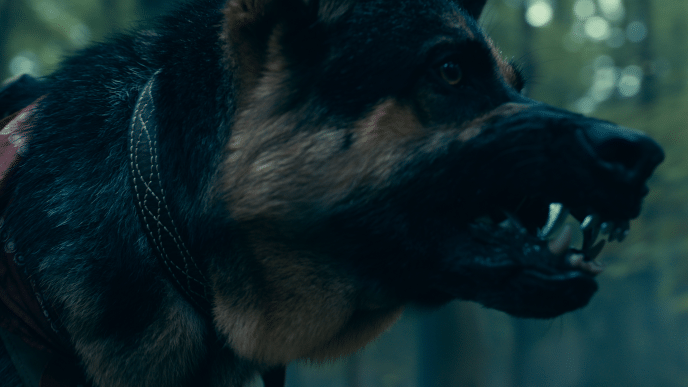
Crucially, the digital performance had to communicate intelligence, loyalty, vulnerability, fear, determination, and affection without anthropomorphizing the animal. Extensive study of canine behavior ensured this authenticity, as pushing specific emotional expressions too far risked making Odin look like an entirely different animal. “The success of the character depends on complete audience belief that Odin is a real dog throughout the film, regardless of whether the shot features a real animal, a digital animal, or a hybrid of both, representing a sophisticated blend of animation, creature development, grooming, look development, lighting, FX, and compositing,” detailed VFX Supervisor Nicolas Chevallier.
The Wolf Pack Attack
The climax of the film's second act features a chaotic night fight where James and Odin are surrounded by a pack of wolves. While the opening of the sequence was shot with husky dogs and practical animatronics, the need for extreme physical violence necessitated a full-CG transition. Shot over several days with stunt performers in gray suits and hand puppets for biting actions, the sequence required the creation of eight CG wolves with distinct characteristics. To ensure the wolves were readable during the quick cuts of the dark scene, the team utilized exaggerated face markings, using references from Japanese Noh theater masks.


To achieve this realistic sense of mass, the team used Framestore's proprietary tool, Fat Solver, which dynamically calculates muscles, fat, and skin together as a single, interconnected unit
"Rather than solving skin and muscle in isolated passes, the system calculates the entire soft-tissue mass as a single volume. This provided the wolves with a realistic sense of inertia and skin-slide that stayed coherent even during the most frantic, high-kinetic choreography." Furthermore, the compositing and simulation teams resolved intricate collisions between the wolves' thick fur and Odin's tactical costume, which included a vest, scarf, and collar.

Because the sequence featured high-contrast lighting and complex interactions, Framestore deployed Fresco and Fragment, proprietary AI machine-learning solvers. They automated the heavy paint-and-roto work, allowing compositors to focus their time on seamlessly integrating the digital creatures into the dark, atmospheric environment.
The Tree Bridge
A pivotal survival sequence required James and Odin to cross a dangerous tree bridge over a rushing river. Because filming over actual rapids was too dangerous, the production utilized a hybrid approach, blending large-scale environment builds with practical photography. The actors were shot on a partial bridge set built on a blue screen backlot in Auckland. Framestore’s environment team was tasked with blending this backlot set with a real river canyon located elsewhere in New Zealand.


"We found the perfect river in New Zealand, but it was inaccessible for a major shoot," says Francois Dumoulin. "Instead, we scanned the entire environment with drones and LiDAR, then reconstructed it in 3D. The scan was used by the Art Department to build the backlot set, so that the proportions would match perfectly with the location and we could plug precisely our studio-shot plates—featuring Brad Pitt on a practical section of the tree—into a CG landscape with real water footage."
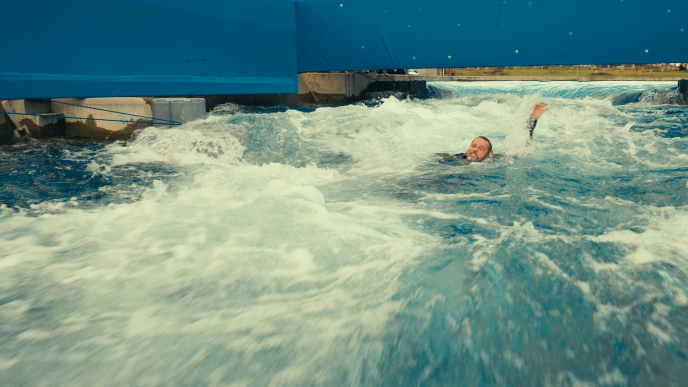

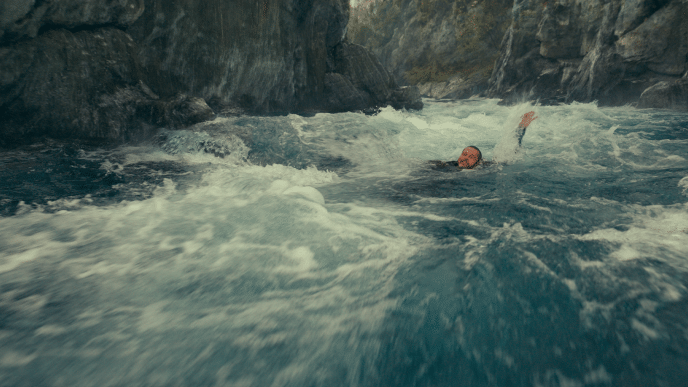
This digital twin served as the foundation for a complex hybrid build. To achieve a perfect physical match, the art department team used the LiDAR data to 3D-print the rocks for the backlot set. In post-production, the team projected plate photography onto the geometry and used digital matte painting to seamlessly fade the studio rocks into the location rocks.
To maintain the New Zealand aesthetic within the Alaskan setting of the film, the team meticulously recreated native plant species using a USD-based instancing pipeline. While simulating wind direction across thousands of digital trees and retaining total creative control over lighting, the team was able to use the practical water photography, maintaining the tactile grit of a location shoot. This methodology integrated scanned data, live-action plates, and CG elements into a single seamless environment, conveying isolation and danger without putting the cast or crew at risk.
Alaska fauna and wilderness
As the narrative progresses, James wanders through a wilderness that increasingly feels suspended between reality and something more surreal. The animals he encounters function as psychological allegories as much as literal physical threats. To reflect this profound narrative weight, the film relies on an aesthetic of "sublimed realism," ensuring the creatures look completely photorealistic while acting as heightened, mythic versions of real animals.


Because Heart of the Beast was shot primarily in natural environments, grounding these digital animals required precise on-set methodologies. To give the director and actors a tangible reference for pacing and performance, Francois Dumoulin collaborated with puppeteer Brian Fisher and his team at Practic Creations to create lightweight, physical puppets for the film's wildlife, which included a grizzly bear, a female moose and her calf, and a pack of wolves.

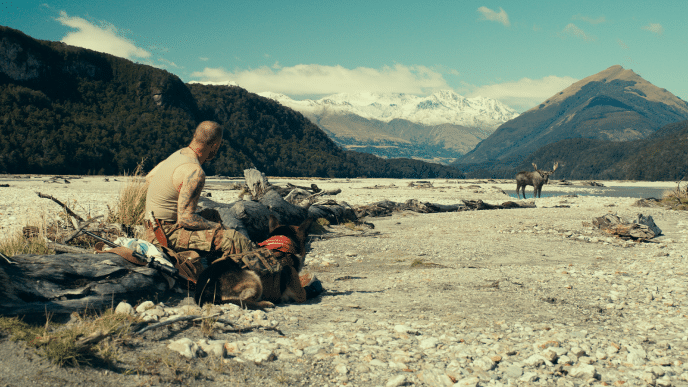
To maintain the director's sublimed realism, these animals could not feel like standard digital set dressing; they required the exact same rigorous anatomical authenticity as the hero creatures. Framestore again utilized the volume-based Fat Solver to calculate the immense muscle mass, heavy tissue jiggle, and complex skin-slide of the grizzly bear as it navigated the uneven, scanned forest terrain. For the moose, the look-dev and grooming teams focused on the complex interplay of coarse, multi-layered fur shading and natural debris. This meticulous attention to detail ensured that every creature encountered by the protagonist carried the tactile weight, physical scale, and unpredictable danger of a true wilderness survival thriller.
Press
Heart of the Beast Used VFX to Hide Dog Changes - Collider BTS
Visual effects is at the heart of storytelling in 'Heart of the Beast' - Befores & Afters
Beyond the wild: merging practical stunts and digital magic in Heart of the Beast - TVB Europe
Au cœur de la bête : l’expertise montréalaise derrière le chien de Brad Pitt - Radio-Canada
Des Québécois derrière les effets visuels du nouveau film de Brad Pitt, «Au coeur de la bête» - Journal de Montréal
Director David Ayer on Shooting and Posting Heart of the Beast - Postperspective

credits
Related case studies
Narnia: The Magician’s Nephew