Framestore Reflects on Unreal Fest Chicago 2026
Following the presentation, "When Mascots Go Live: Converting the GEICO Gecko to Real-Time," Senior Technical Animator Kamila Bianchi and Technical Director Claude Dareau look back on the conversations, technologies, and industry shifts that defined this year's Unreal Fest Chicago. From the future of real-time production to the role of AI and why human connection still matters most, here are their biggest takeaways.

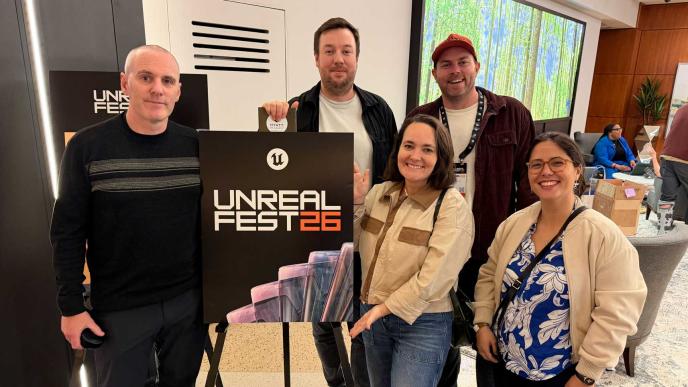
More than technology, it was about community
For Kamila, the defining moments of Unreal Fest weren't confined to the keynote stage. She expresses,
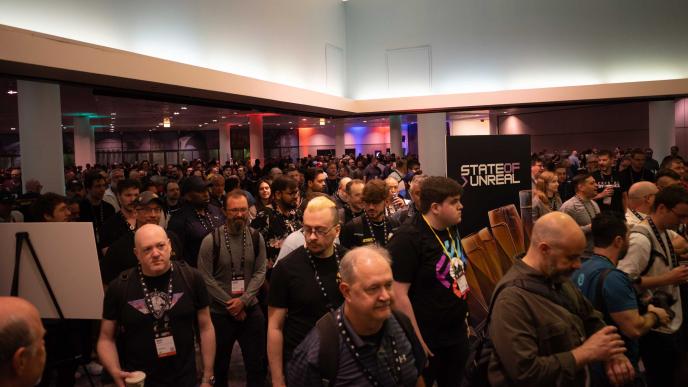
"The highlight for me wasn't the talks or even the announcements during State of Unreal. It was meeting people in person. Having conversations in the corridors before sessions, recognising people you've only known online, and connecting over lunch with younger developers who are excited about shaping the future of immersive experiences. In a post-COVID world, we're all missing that human connection, and Unreal Fest really brought that back."
While Epic unveiled a wealth of new technology, it was those informal conversations that revealed where the industry is heading and the enthusiasm of the community driving it there.
Unreal is becoming the production pipeline
One of the strongest themes throughout the conference was the industry's growing confidence in Unreal Engine as a complete production environment.
"There were a lot of talks about moving pipelines entirely into Unreal," Kamila explains. "It was the first time I'd seen so many examples of productions using Unreal end-to-end, rather than isolated experiments. Epic has clearly invested heavily in making that possible."
Claude noticed the same trend from a technical perspective, particularly around animation tools evolving to the point where teams may begin relying less on traditional DCC applications.
"The animation toolset inside Unreal has matured significantly," he says. "I can absolutely see teams beginning to replace parts of their Maya workflows as these tools continue to develop."
AI is here but so is healthy scepticism
Artificial intelligence was impossible to ignore throughout the event, although the mood among attendees was more measured than enthusiastic.
"Epic is clearly investing heavily in AI," says Claude. "Their implementation of MCP, in particular, looks incredibly well thought out and has real potential for development teams like ours."
For Claude, however, the bigger takeaway wasn't AI replacing artists, it was how AI can complement existing creative workflows.
"This project reinforced my belief that real-time production will remain incredibly important. I don't think the future is simply prompting an AI and accepting whatever it generates. Creative people still need a three-dimensional world they can direct, iterate on and control. AI will become another part of the pipeline, not the pipeline itself."
Where brands should be paying attention
As brands increasingly look for ways to engage audiences beyond traditional campaigns, both Kamila and Claude see significant opportunities emerging through real-time experiences.
For Kamila, success means meeting audiences where they already are.
"Brands should be thinking about bringing their characters into existing interactive platforms like Fortnite, rather than expecting audiences to come to them."
Claude agrees but believes the longer-term opportunity extends beyond placing characters inside virtual worlds.
"The really interesting idea is portability—not simply moving a character between games, but creating characters with their own behaviours, personality and internal logic that can move between experiences. Imagine a brand mascot appearing in a livestream, hosting a live event, or interacting naturally through holographic displays without needing to be rebuilt each time."
Lessons from bringing the Gecko into real time
Developing the real-time GEICO Gecko challenged the team to rethink long-established production methods.
"For me," says Kamila, "the biggest lesson was asking what tools and solutions already exist outside our traditional pipeline, and how we can build on them instead of always starting from scratch."
Claude believes the project also pointed towards a future where digital characters become increasingly autonomous.
"We began exploring the idea that characters shouldn't simply be animated puppets controlled entirely by software. Instead, they can have their own behavioural logic and intelligence. In an era where large language models are becoming commonplace, that's an incredibly powerful direction."
A conversation that clearly resonated
Kamila's presentation was warmly received, prompting discussions around production speed, animation techniques, and whether similar workflows could be applied to other established brand mascots.
"What really resonated was seeing how relatively small animation decisions and simple creative ideas can produce something that feels unique," Kamila says. "There was a lot of interest in how quickly the project came together and whether the approach could be replicated for other characters. That tells me there's a real appetite for interactive experiences featuring well-known mascots."
The session also introduced many attendees to a different side of Framestore.
"A lot of people were surprised to learn that Framestore is doing this kind of immersive work in Unreal," Kamila reflects.
Claude left with a similar impression.
"The talk was very warmly received. People responded really positively—not just to the technology, but to the character, the story behind the project and what it represents."
Looking ahead
For both speakers, Unreal Fest reinforced that real-time technology is no longer an emerging capability but an essential creative platform.
Just as importantly, it highlighted the importance of being part of the conversation.
"Having Framestore present at events like this shows that we do so much more than film and television," says Kamila. "These are the spaces where the future of storytelling, marketing and immersive experiences is being shaped. It's important that we're there, contributing to that conversation."
Claude agrees.
"Overall, it was an incredibly positive experience and not just attending, but presenting. We should absolutely be doing more of both!"
Related News

The Howler on AI in the VFX Toolkit

Business Insider on Geico Gecko's Live Interview
